| Pharmacodynamics |
Atorvastatin, as well as some of its metabolites, are pharmacologically active in humans. The liver is the primary site of action and the principal site of cholesterol synthesis and LDL clearance. Drug dosage, rather than systemic drug concentration, correlates better with LDL-C reduction. Individualization of drug dosage should be based on the therapeutic response.
|
| Pharmacokinetics |
Absorption: – Atorvastatin is rapidly absorbed after oral administration. – Maximum plasma concentration occurs within 1 to 2 hours. – The extent of absorption increases in proportion to the atorvastatin dose. – The absolute bioavailability of atorvastatin is approximately 14%. – The systemic availability of HMG-CoA reductase inhibitory activity is approximately 30%. – Food decreases the rate and extent of drug absorption by approximately 25% and 9%, respectively. Distribution – Mean volume of distribution is approximately 381 liters. – Atorvastatin is 98% bound to plasma proteins. – Atorvastatin is likely to be secreted in human milk. Metabolism – Atorvastatin is extensively metabolized to ortho- and parahydroxylated derivatives and various betaoxidation products. – The In-vitro inhibition of HMG-CoA reductase by ortho- and parahydroxylated metabolites is equivalent to that of Atorvastatin. – Approximately 70% of circulating inhibitory activity for HMG-CoA reductase is attributed to active metabolites. – In-vitro studies suggest the importance of cytochrome P450 3A4 in atorvastatin metabolism. Excretion – Atorvastatin and its metabolites are eliminated primarily in bile following hepatic and/or extra-hepatic metabolism. – The mean plasma elimination half-life is approximately 14 hours. – The half-life of inhibitory activity for HMG-CoA reductase is 20 to 30 hours due to the contribution of active metabolites. – Less than 2% of a dose of Atorvastatin is recovered in urine following oral administration.
|
| Indications and Usage |
Atorvastatin is an HMG-CoA reductase inhibitor (statin) indicated as an adjunct to diet to: Reduce the Risk of Cardiovascular Disease in Adults: – Reduce the risk of Myocardial Infarction (MI), stroke, revascularization procedures, and angina in patients with established coronary heart disease (CHD) or with multiple risk factors for CHD but without clinically evident CHD. – Reduce the risk of MI and stroke in adult patients with Type 2 Diabetes Mellitus who have multiple risk factors but without clinically evident CHD. Hyperlipidemia and Mixed Dyslipidemia: – Reduce elevated Total-C, LDL-C ('bad cholesterol'), Apo B, and Triglyceride (TG) levels and increase HDL-C ('good cholesterol') in adult patients with: – Primary hypercholesterolemia (heterozygous familial and nonfamilial). – Mixed dyslipidemia (Fredrickson Types IIa and IIb). – Reduce elevated TG in patients with hypertriglyceridemia (Fredrickson Type IV) and primary dysbetalipoproteinemia (Fredrickson Type III). -Reduce Total-C and LDL-C in patients with Homozygous Familial Hypercholesterolemia (HoFH), typically as an adjunct to other lipid-lowering treatments. Pediatric Use (Ages 10-17): As an adjunct to diet to reduce Total-C, LDL-C, and Apo B levels in pediatric patients (10 years to 17 years of age) with Heterozygous Familial Hypercholesterolemia (HeFH) when diet therapy alone is inadequate.
|
| Administration and Dosage |
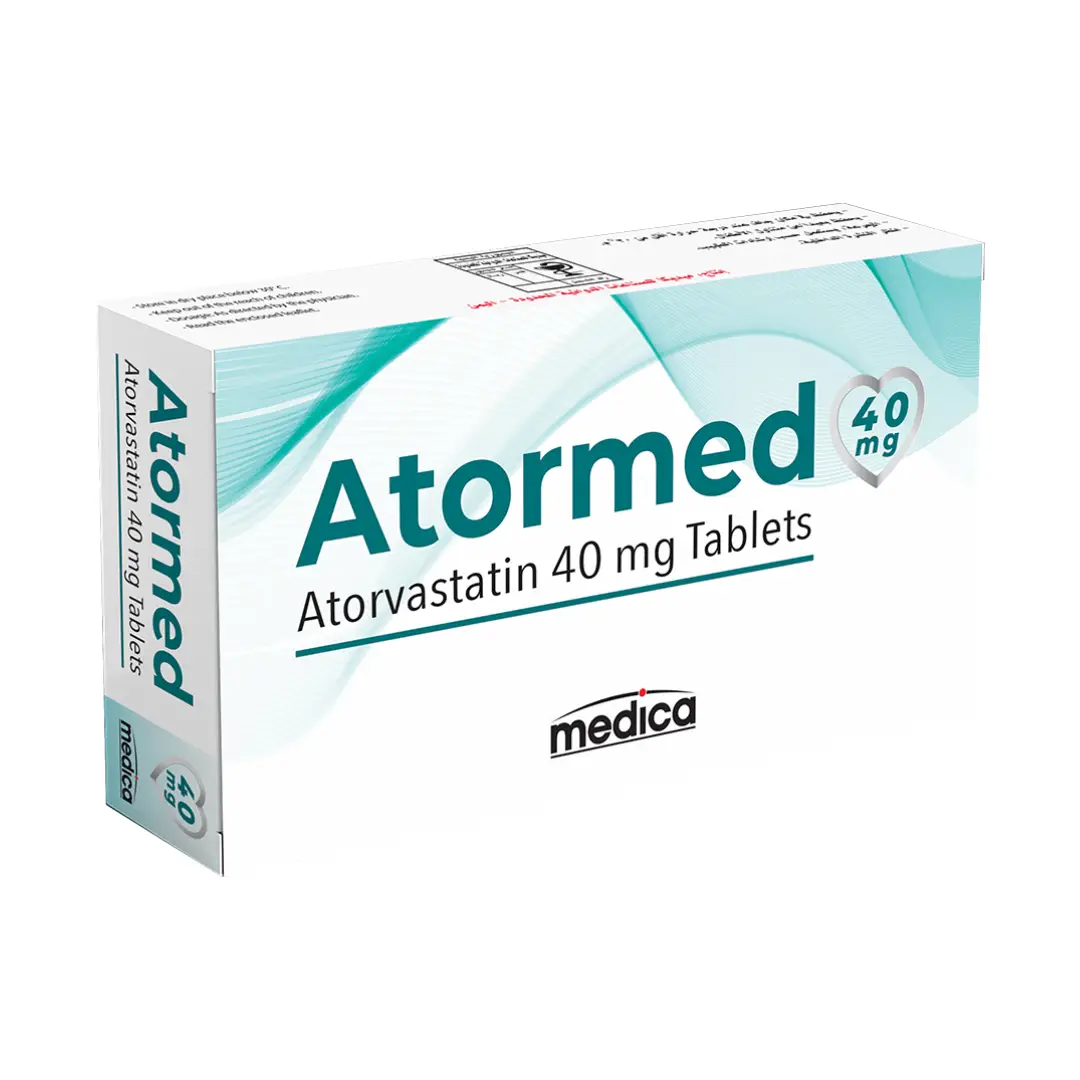
Adults – Hyperlipidemia and Mixed Dyslipidemia: – Recommended Starting Dose: 10 mg or 20 mg once daily. – Patients requiring a large reduction in LDL-C (e.g., more than 45%) may start at 40 mg once daily. – Dosage Range: 10 mg to 80 mg once daily. – Dose Adjustment: Doses should be individualized based on the goal of therapy and patient response. Lipid levels should be analyzed within 2 to 4 weeks after initiation or titration, and the dosage adjusted accordingly. General Administration: – Atorvastatin can be administered as a single dose once daily. – It can be taken with or without food. – It is recommended to take it at around the same time every day to maintain consistent blood levels. The starting dose and maintenance doses of Atormed tablets should be individualized according to patient characteristics such as goal of therapy and response, After initiation and/or upon titration the lipid levels should be analyzed within 2 to 4 weeks and dosage adjusted accordingly. Heterozygous Familial Hypercholesterolemia in Pediatric Patients 10 Years to 17 Years of Age (is an inherited genetic disorder in which the child inherit one abnormal gene from one parent only): – The recommended starting dose of Atormed tablets is 10 mg/day; the usual dose range is 10 to 20 mg orally once daily. Adjustments should be made at intervals of 4 weeks or more, Homozoygous Familial Hypercholesterolemia (inherited genetic disorder in which the child inherit abnormal gene from each parent): – The dosage of Atormed tablets in patients with HoFH is 10 to 80 mg daily.
|
| Contraindications |
– Active liver disease, which may include unexplained persistent elevations in hepatic transaminase levels – Hypersensitivity to any component of this medication – Pregnancy – Lactation
|
| Warnings and precautions |
Myopathy and Rhabdomyolysis: Atorvastatin may cause myopathy (muscle pain, tenderness, or weakness with creatine kinase (CK) above ten times the upper limit of normal) and rhabdomyolysis (with or without acute renal failure secondary to myoglobinuria). Liver Dysfunction: Statins, like some other lipid-lowering therapies, have been associated with biochemical abnormalities of liver function. Persistent elevations (>3 times the upper limit of normal [ULN] occurring on 2 or more occasions) in serum transaminases occurred in 0.7% of patients who received Atorvastatin in clinical trials. The incidence of these abnormalities was 0.2%, 0.2%, 0.6%, and 2.3% for 10, 20, 40, and 80 mg, respectively. So it is recommended that liver enzyme tests be obtained prior to initiating therapy with Atorvastatin and repeated as clinically indicated. Endocrine Function: Increases in HbA1c and fasting serum glucose levels have been reported with HMG-CoA reductase inhibitors, including atorvastatin. Caution should be exercised if a statin is administered concomitantly with drugs that may decrease the levels or activity of endogenous steroid hormones, such as ketoconazole, spironolactone, and cimetidine.
|
| Adverse Reactions |
Clinical adverse reactions occurring in >2 in patients treated with any dose of Atorvastatin calcium and at an incidence greater than placebo regardless of causality (% of Patients) including: Nasopharyngitis, Arthralgia, Diarrhea, Pain in extremity, Urinary tract infection, Dyspepsia, Nausea, Musculoskeletal pain, Muscle Spasms, Myalgia, Insomnia, Pharyngolaryngeal pain.
|
| Drug interaction |
Drug Interactions that may Increase the Risk of Myopathy and Rhabdomyolysis with Atorvastatin: Atorvastatin calcium is metabolized by CYP3A4, so Atorvastatin calcium plasma levels can be significantly increased with concomitant administration of inhibitors of CYP3A4 and may increase the risk of myopathy and rhabdomyolysis when used concomitantly. These drugs include: •Cyclosporine or gemfibrozil •Select azole antifungals or macrolide antibiotics •Fibrates (other than gemfibrozil) •Grapefruit juice •Anti-viral medications •Niacin •Colchicine Some Drug Interactions that may Decrease plasma levels of Atorvastatin: •Co-administration of Atorvastatin calcium with Rifampin lead to decrease plasma levels of Atorvastatin Atorvastatin calcium Effects on Other Drugs •Co-administration of Atorvastatin calcium and an oral contraceptive increased plasma concentrations of norethindrone and ethinyl estradiol •When multiple doses of Atorvastatin calcium and digoxin were co-administered, plasma digoxin concentrations increased.
|
| Use in Specific Population |
Pregnancy: Atorvastatin calcium is contraindicated for use in pregnant women Lactation: Atorvastatin calcium use is contraindicated during breastfeeding Pediatric Use: The safety and effectiveness of Atorvastatin calcium have been established in pediatric patients, 10 years to 17 years of age in treating Heterozygous Familial Hypercholesterolemia (HeFH) Hepatic Impairment: Atorvastatin calcium is contraindicated in patients with active liver disease which may include unexplained persistent elevations in hepatic transaminase levels
|

Reviews
There are no reviews yet.