
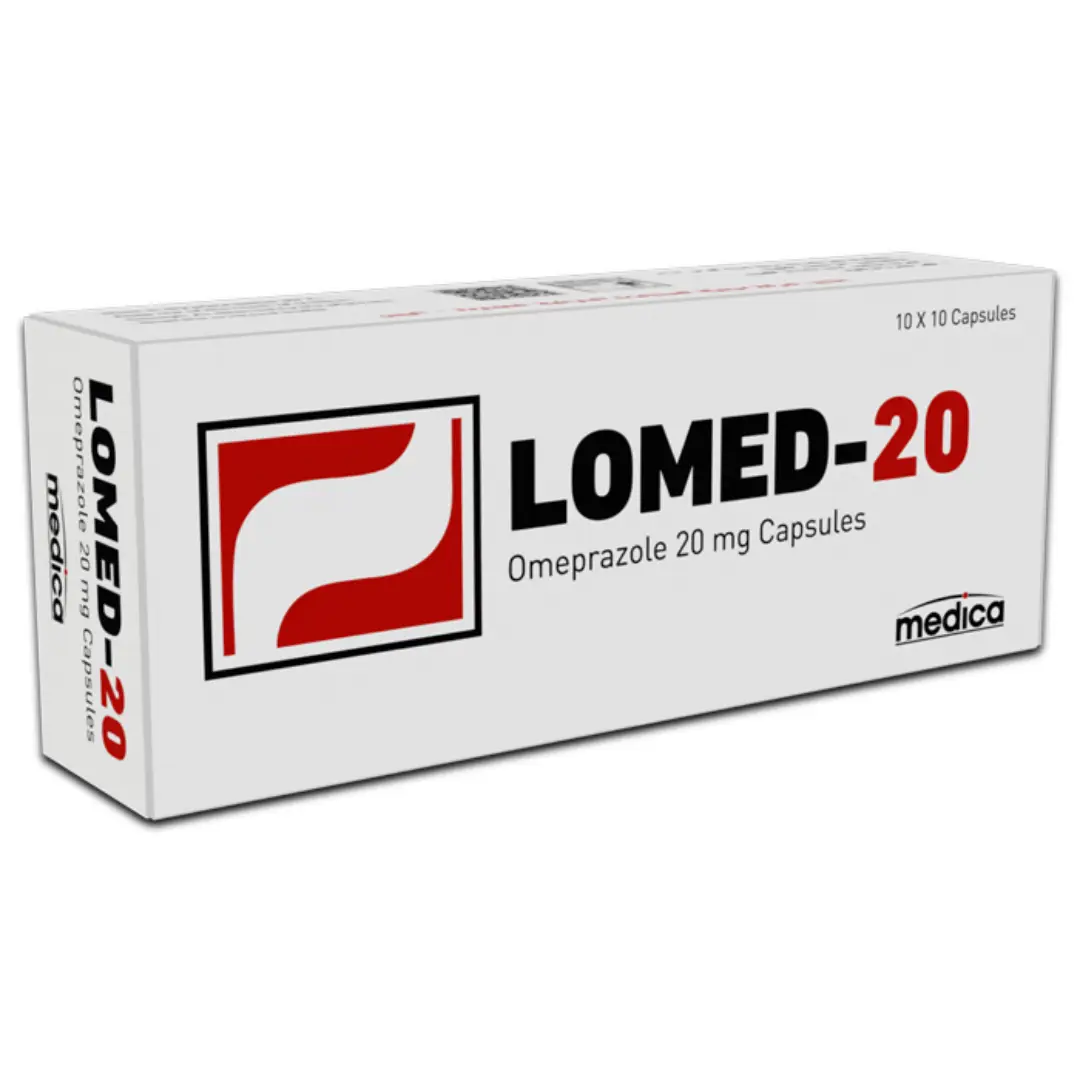
LOMED-20

Category: Capsule
Classification: Gastrointestinal System Drugs
Product English Name: LOMED-20
Product Arabic Name: لوميد-20
Scientific Name English: Omeprazole
Scientific Name Arabic: اوميبرازول
Product Unit: 10 x 10 capsules
Product Strength:
20mg / capsule

Categories: ,

Description

Clinical Pharmacology

Mechanism of Action
Omeprazole is a proton pump inhibitor. It is a substituted benzimidazole that belongs to the antisecretory class of compounds. It inhibits irreversibly the parietal cells H+ / K+ ATP pump, the final step of acid production.

Additional information

Pharmacodynamics

Omeprazole suppresses gastric basal secretion from parietal stomach cells and stimulated acid secretion due to stimulus. The inhibitory effects of omeprazole occur rapidly within 1 hour of administration, with the maximum effect occurring in 2 hours. The inhibitory effects last for approximately 72 hours after administration, the effects will plateau on the fourth day with daily use of the medication. When the drug is discontinued, secretory activity returns gradually over 3 to 5 days.

Pharmacokinetics

Absorption: Delayed-release Omeprazole capsules contain enteric-coated pellets that only release omeprazole once the drug leaves the stomach. Once the drug is released, it is rapidly absorbed. It has an absolute bioavailability of 30 to 40 % (20 to 40 mg oral dose), and the peak plasma concentration is attained in 0.5 to 3.5 hours. Distribution: Plasma protein binding is approximately 95% Metabolism: It is metabolized mainly via the cytochrome P450 system. The major part of its metabolism is dependent on the polymorphically expressed CYP2C19. Elimination: It is eliminated mainly in urine as an unchanged drug and its metabolites. Its plasma half-life is 0.5 to 1 hour after oral administration in healthy subjects.

Indications of Usage

– Treatment of active duodenal ulcer in adults – Eradication of helicobacter pylori to reduce the risk of duodenal ulcer recurrence in adults – Treatment of active benign gastric ulcer in adults – Treatment of symptomatic gastroesophageal reflux disease (GERD) in patients 2 years of age and older – Treatment of erosive esophagitis (EE) due to acid-mediated (GERD) in patients 2 years of age and older. – Maintenance of healing of EE due to acid-mediated GERD in patients 2 years of age and older – Pathologic hypersecretory conditions in adults (e.g., Zollinger-Ellison syndrome, multiple endocrine adenomas and systemic mastocytosis) in adults.

Dosage & Administration

Omeprazole should be ingested in 30 to 60 minutes before meals. It may be taken with antacids. When taken twice daily, the first dose should be before breakfast and the second dose before dinner. The capsule should be swallowed whole, not crushed or chewed. 1. Treatment of active duodenal ulcer in adults: 20mg once daily for 4 weeks; some patients may require an additional 4 weeks 2. H. pylori Eradication to reduce the risk of duodenal ulcer recurrence: a. Triple therapy: Omeprazole capsules 20 mg plus Amoxicillin 1000 mg plus Clarithromycin 500mg. Take all three drugs twice daily for 10 days. b. In patients with an ulcer present at the time of initiation of therapy, continue omeprazole capsules 20mg once daily for an additional 18 days of ulcer healing and symptom relief. 3. Active benign gastric ulcer: 40mg once daily for 4 to 8 weeks 4. Symptomatic GERD: 20mg once daily for up to 4 weeks 5. EE due to Acid-Mediated GERD: 20mg once daily for 4 to 8 weeks, an additional 4 weeks of treatment may be given if no response; if recurrence additional 4-to-8-week courses may be considered. 6. Maintenance of Healing of EE due to Acid-Mediated GERD: 20mg once daily for up to 12 months 7. Pathological hypersecretory conditions: Starting dose is 60mg once daily (varies with individual patient) as long as clinically indicated.

Contraindications

– Patients with known hypersensitivity to substituted benzimidazoles or any component of the formulation – Patients receiving treatment of HIV such as atazanavir

Warnings and Precautions

Be aware if the following conditions are present or occur while the patient taking omeprazole: – Gastric Malignancy: in adults, symptomatic response does not preclude the presence of gastric malignancy – Acute Interstitial Nephritis: Observed in patients taking PPIs. – Clostridium difficile-associated diarrhea: PPI therapy may be associated with increased risk of diarrhea – Bone Fracture: Long-term and multiple daily dose PPI therapy may be associated with an increased risk of osteoporosis-related fractures of the hip, wrist or spine. – Cutaneous and systemic Lupus Erythematous: Mostly cutaneous: new onset or exacerbation of existing disease; discontinue Omeprazole and refer to specialist for evaluation – Interaction with clopidogrel: avoid concomitant use of some PPI’s – Cyanocobalamin (Vitamin B-12) Defieciency: Daily long-term use (e.g., longer than 3 years) may lead to malabsorption or a deficiency of cynacobalamin. – Hypomagnesaemia: Reported rarely with prolonged treatment with PPIs. – Interaction with St. John’s Wort or Rifampin: Avoid concomitant use of Omeprazole – Interactions with Diagnostic Investigations for Neuroendocrine Tumors – Interaction with Methotrexate: Concomitant use with PPIs may elevate and/or prolong serum concentrations of methotrexate and/or its metabolite, possibly leading to toxicity. With high dose methotrexate administration, consider a temporary withdrawal of Omeprazole.

Adverse Reactions

Adults: – Most common adverse reactions in adults (incidence >2%) are headache, abdominal pain, nausea, diarrhea, vomiting and flatulence. Paediatric patients (1 to 16 years of age): – Safety profile similar to that in adults, except that respiratory system events and fever were the most frequently reported reactions in paediatric studies. Drug Interaction – Concomitant treatment of omeprazole with ketoconazole, atazanavir, iron salts, erlotinib, and mycophenolate mofetil (MMF) can decrease the absorption of such drugs. – Omeprazole can prolong prothrombin time when used with warfarin. So monitoring of prothrombin time is necessary – Drugs known to induce CYP2C19 or CYP3A4 (such as Rifampin, St. John’s Wort) may lead to decreased omeprazole serum levels – Omeprazole is an inhibitor of CYP2C19 enzyme. When used concomitantly with Clopidogrel it decreases its efficacy. – Concomitant administration of PPIs and methotrexate may elevate and prolong serum levels of methotrexate.

Use in Specific Population

Pregnancy and breast-feeding: The drug should be used during pregnancy only if the potential benefit outweighs the potential risk of the fetus. Because omeprazole is excreted in human milk, a decision should be made to discontinue nursing or to discontinue the drug. Patient with Hepatic Impairment: The bioavailability in patients with hepatic impairment increased by 100% compared to the I.V. dose due to a decrease in the first-pass effect. Plasma half-life also increased to 3 hours instead of 0.5 to 1 hour. Dose reduction should be considered for patients with hepatic impairment. Patient with Renal Impairment: There is no dose adjustment guidance for patients with renal impairment or with creatinine clearance ranging between 10 to 62 ml/min/1.73 m2. A slight increase in bioavailability was observed in the patient with renal impairment as a primary route of excretion of omeprazole metabolites; their elimination slowed in proportion to the decreased creatinine clearance. Geriatric Use: Omeprazole was administered to over 2000 elderly individuals (>65 years of age) in a clinical trial in the U.S. and Europe. There were no differences in safety and effectiveness between the elderly and the younger subjects.

Reviews

There are no reviews yet.

Be the first to review “LOMED-20”

Your email address will not be published. Required fields are marked *