| Composition |
Each Film-Coated Tablet Contains:
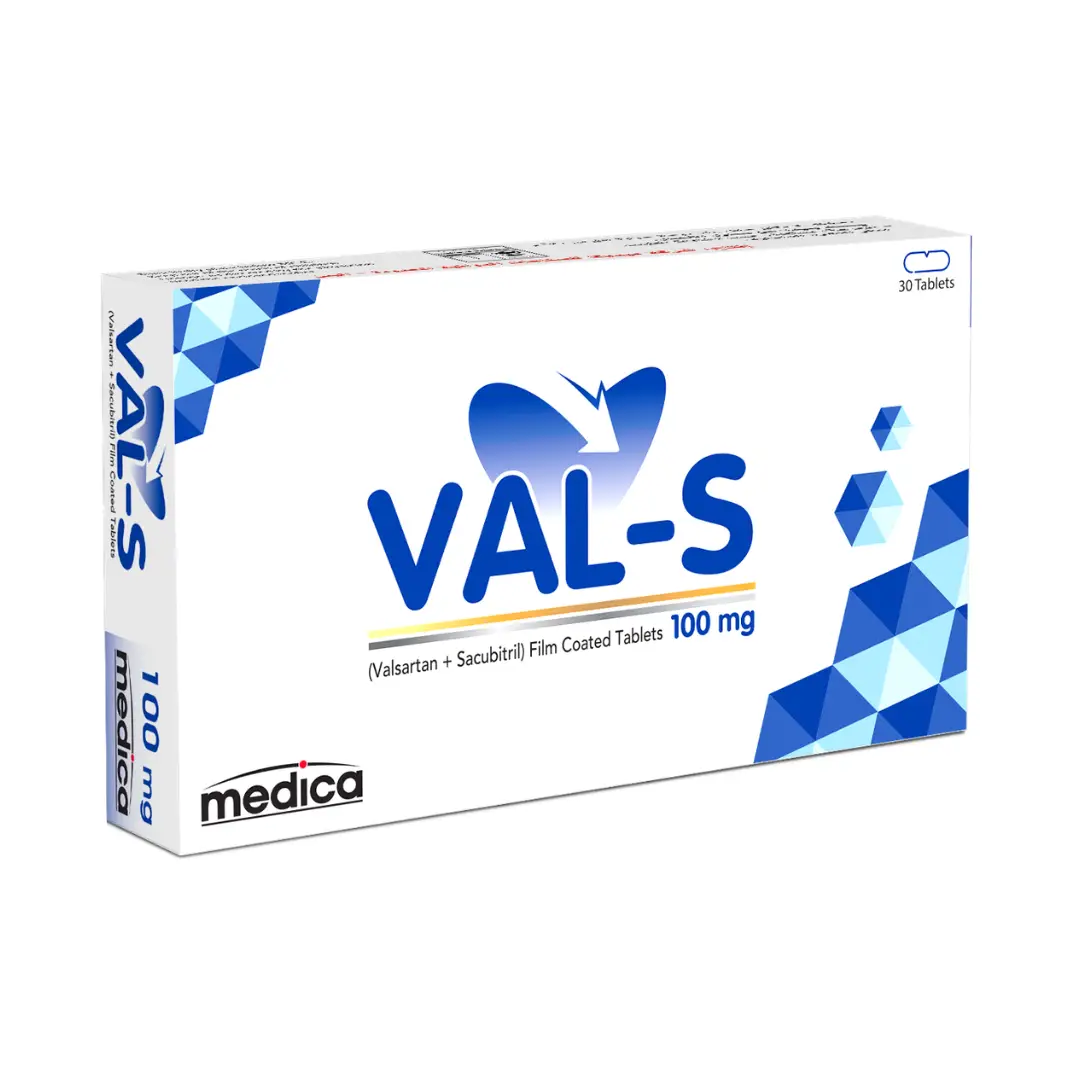
Sacubitril/Valsartan 50 mg, 100 mg, 200 mg.
(As complex).
Drug Class: Angiotensin Receptor-Neprilysin Inhibitor (ARNI).
|
| Clinical Pharmacology |
Mechanism of Action:
Sacubitril/Valsartan contains sacubitril, a neprilysin inhibitor, and valsartan, an angiotensin II receptor blocker. Sacubitril is converted to its active metabolite (LBQ657), which inhibits neprilysin, leading to increased levels of peptides such as natriuretic peptides. Valsartan blocks the angiotensin II type-1 (AT₁) receptor, reducing the effects of angiotensin II, including aldosterone release. The combined effect enhances cardiovascular and renal function in heart failure patients.
|
| Pharmacodynamics |
Multiple doses of sacubitril/valsartan in healthy subjects and heart failure patients consistently show neprilysin inhibition combined with renin-angiotensin system blockade. Clinical studies in heart failure with reduced ejection fraction (HFrEF) and preserved ejection fraction (HFpEF) patients demonstrated increased natriuresis, elevated urinary and plasma cGMP, and significant reductions in NT-proBNP, aldosterone, and endothelin-1 levels.
|
| Pharmacokinetics |
Absorption:
After oral intake, sacubitril/valsartan separates into sacubitril and valsartan; sacubitril is metabolized to active LBQ657. The peak plasma concentrations of sacubitril, LBQ657, and valsartan are reached in 0.5 hours, 2 hours, and 1.5 hours, respectively. Sacubitril’s bioavailability is ≥60%, and the valsartan in sacubitril and valsartan tablets is more bioavailable in other marketed tablet formulations. Food does not significantly affect drug exposure, so it can be taken with or without food.
Distribution:
Sacubitril, LBQ657, and valsartan are highly bound to plasma proteins (94–97%). LBQ657 crosses the blood-brain barrier minimally (0.28%). The apparent volumes of distribution are approximately 75 L for valsartan and 103 L for sacubitril.
Metabolism:
Sacubitril is rapidly converted to LBQ657 by esterases and is not significantly metabolized further. Valsartan undergoes minimal metabolism, with approximately 20% recovered as metabolites. A low-concentration hydroxyl metabolite is present in plasma.
Excretion:
After oral administration, 52% to 68% of sacubitril (mainly as LBQ657) and approximately 13% of valsartan and its metabolites are excreted in urine. Fecal excretion accounts for 37% to 48% of sacubitril (mainly LBQ657) and 86% of valsartan and its metabolites. The mean elimination half-life is approximately 1.4 hours for sacubitril, 11.5 hours for LBQ657, and 9.9 hours for valsartan.
Before You Start VAL-S:
Tell your doctor if you:
• Have a history of hereditary angioedema.
• Have kidney or liver problems.
• Have diabetes.
• Are pregnant or planning to become pregnant.
• Are breastfeeding.
|
| Indications and Usage |
Adult Heart Failure:
VAL-S is indicated to reduce the risk of cardiovascular death and hospitalization for heart failure in adult patients with chronic heart failure.
Pediatric Heart Failure:
VAL-S is indicated for treating symptomatic heart failure with systemic left ventricular systolic dysfunction in pediatric patients aged one year and older.
|
| Dosage and Administration |
Adults: Start with 100 mg orally twice daily. After 2 to 4 weeks, increase to the maintenance dose of 200 mg twice daily, as tolerated.
Pediatrics: Aged 1 year and older, VAL-S should be taken twice a day orally. Dosage adjustments should be made every 2 weeks based on patient tolerance.
Weight (kg):
1. Less than 40 kg*
– Starting Dose: 1.6 mg/kg
– Second Dose: 2.3 mg/kg
– Final Dose: 3.1 mg/kg
2. 40 to less than 50 kg
– Starting Dose: 50 mg
– Second Dose: 100 mg
– Final Dose: 150 mg
3. 50 kg and above
– Starting Dose: 100 mg
– Second Dose: 150 mg*
– Final Dose: 200 mg
*Use of the oral suspension is recommended in these patients. Recommended mg/kg doses are of the combined amount of both sacubitril and valsartan. Doses of 150 mg can be achieved using three 50 mg tablets.
Administration Guide:
• A 36-hour washout period is required when switching from an ACE inhibitor to avoid the risk of angioedema.
• For pediatric patients, an oral suspension should be used. Consult your doctor or pharmacist for detailed instructions on preparation.
|
| Contraindications |
Sacubitril/Valsartan is contraindicated in:
• Patients with hypersensitivity to any of its components.
• Patients with a history of angioedema related to previous ACE inhibitor or ARB use.
• Concomitant use with ACE inhibitors (a 36-hour washout is required when switching).
• Concomitant use with aliskiren in patients with diabetes.
|
| Warnings and Precautions |
Fetal Toxicity: May cause fetal harm, especially during the second and third trimesters. Discontinue use if pregnancy is detected unless no suitable alternative exists.
Angioedema: May occur and can be life-threatening, especially with laryngeal involvement. Discontinue immediately if angioedema occurs.
Hypotension: May cause symptomatic hypotension, especially in volume or salt depleted patients. Correct underlying causes and adjust dose if needed.
Hyperkalemia: Risk of elevated serum potassium; monitor levels regularly, especially in high-risk patients (e.g., renal impairment, diabetes). Dose adjustment or interruption may be required.
|
| Use in Special Populations |
Patients with Renal Impairment:
No dose adjustment is needed for patients with mild to moderate renal impairment. For severe renal impairment, start with half the usual dose in adults and pediatric patients with heart failure. Pediatric patients weighing 40–50 kg should start at 0.8 mg/kg twice daily using the oral suspension.
Patients with Hepatic Impairment:
No dose adjustment is needed for patients with mild hepatic impairment. For moderate impairment, start with half the usual dose in adults and pediatric patients. Use is not recommended in patients with severe hepatic impairment due to a lack of data.
Pregnancy:
Sacubitril/Valsartan may cause fetal harm when administered during pregnancy, especially in the second and third trimesters, leading to reduced fetal kidney function, increased morbidity, and mortality. If pregnancy is detected, discontinue sacubitril/valsartan and consider alternative treatments unless no suitable option exists and the drug is essential for the mother.
Lactation:
There is no data on sacubitril/valsartan presence in human milk or its effects on breastfed infants. It is found in rat milk, and due to potential serious risks, breastfeeding is not recommended during treatment with sacubitril/valsartan.
Pediatric Usage:
Sacubitril/Valsartan is proven safe and effective for treating heart failure in pediatric patients aged 1 to 18 years, with a safety profile similar to adults. Data for patients under 1 year old are limited and insufficient to conclude on safety and efficacy.
Geriatric Use:
A large proportion of patients aged 65 years and older have been treated with sacubitril/valsartan. No overall differences in safety or effectiveness were observed compared to younger adult patients.
|
| Side Effects/Adverse Reactions |
Common: Abdominal or stomach pain, blurred vision, confusion, difficulty breathing, dizziness or lightheadedness on standing, irregular heartbeat, nausea or vomiting, nervousness, numbness or tingling in hands, feet, or lips, sweating, unusual tiredness or weakness, leg weakness or heaviness.
Less Common: Bloody urine, decreased urine output, increased thirst, loss of appetite, lower back or side pain, swelling of the face, fingers, or lower legs, and weight gain.
Rare: Extensive hive-like swelling (angioedema) affecting the face, eyelids, lips, tongue, throat, extremities, or genital area.
|
| Drug Interactions |
Dual RAAS Blockade: Do not use sacubitril/valsartan with ACE inhibitors due to increased risk of angioedema. Avoid combining with ARBs since valsartan is included. Use with aliskiren is contraindicated in diabetic patients.
Potassium-Sparing Diuretics: Concomitant use may increase serum potassium levels; monitor accordingly.
NSAIDs (including COX-2 inhibitors): May worsen renal function, especially in elderly, volume-depleted, or renally impaired patients; monitor kidney function.
Lithium: May increase lithium levels and risk of toxicity; monitor lithium levels during concurrent use.
|
| Storage Conditions |
Store in a dry place below 30°C.
VAL-S 50 mg, 100 mg
Pack Size: 2 blisters (Alu/Alu), each blister contains 15 tablets.
VAL-S 200 mg
Pack Size: 3 blisters (Alu/Alu), each blister contains 10 tablets.
|

Reviews
There are no reviews yet.